Halifax Collision Reporting Centre: Location, Hours & What to Bring
⚡ Quick Answer
Halifax does not have a standalone collision reporting centre — the dedicated centre closed in 2015. Instead, you report collisions at Halifax Regional Police Headquarters, 1975 Gottingen Street (open 24/7). You can also report by email to hrpsot@halifax.ca. Bring your driver’s licence, vehicle registration, proof of insurance, and details of the collision. You’ll receive a GO# (General Occurrence Number) that your insurance company requires. Need your vehicle towed to file your report? Call Halifax Towing at (902) 593-3918.
If you’ve just been in a car accident in Halifax and you’re searching for a collision reporting centre near me or collision centre near me, you’re not alone — it’s one of the most common searches after a collision in the HRM. The problem is that most of the information online is outdated or refers to Ontario-style centres that don’t exist here.
Halifax had a dedicated collision reporting centre at Police Headquarters that operated as a pilot project in 2014–2015. That centre closed, and the reporting process has changed significantly since then. This guide gives you the current, accurate process for reporting a vehicle collision in Halifax — where to go, what to bring, how to file by email, and how to get the GO# your insurance company needs.
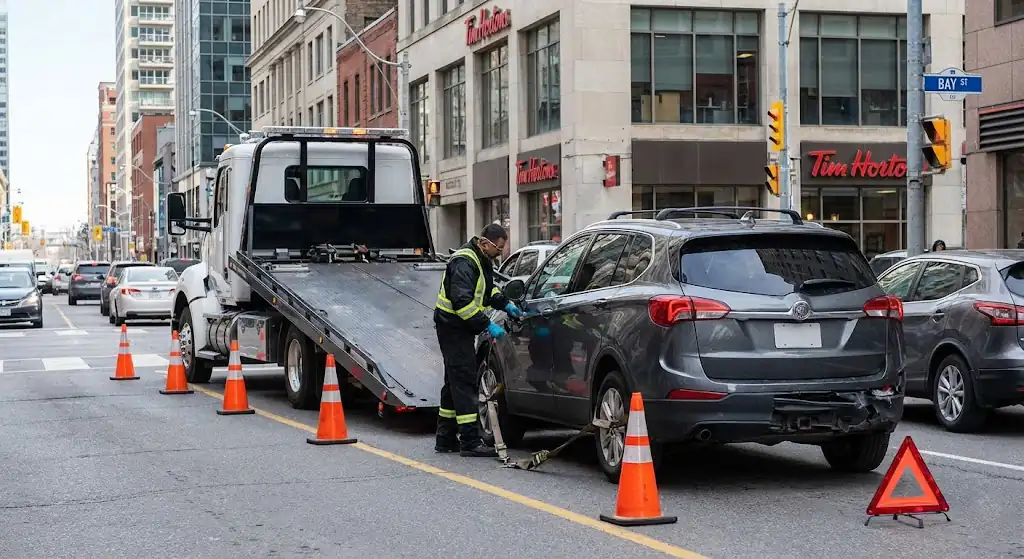
If your vehicle isn’t driveable after the collision, Halifax Towing provides 24/7 accident towing and can transport your vehicle to the police station or directly to a body shop.
🚨 Is Someone Injured? Call 911 Immediately.
If anyone is hurt, there’s a danger to other traffic, or a crime is involved (impaired driving, hit-and-run), call 911 first. Do not leave the scene. This guide covers reporting after the immediate emergency has been handled.
📍 Where to Report a Collision in Halifax (Current Locations)
There are three ways to file a collision report with Halifax Regional Police in 2026. The method you choose depends on your situation and how urgently you need your GO#:
Halifax Regional Police Headquarters
1975 Gottingen Street, Halifax, NS
Hours (Collision Reporting)
24 hours / 7 days a week
Full Reception Services
Mon–Fri, 8:30 AM – 4:00 PM
Dedicated parking available in front of headquarters. This is the only location that accepts collision reports around the clock.
East Division Office (Dartmouth)
7 Mellor Avenue, Dartmouth, NS
Hours
Mon–Fri, 8:30 AM – 4:00 PM
Convenient for Dartmouth and Cole Harbour residents. Closed weekends and statutory holidays.
West Division Office (Bedford)
15 Convoy Run, Bedford, NS
Hours
Mon–Fri, 8:30 AM – 4:00 PM
Serves Bedford, Clayton Park, and surrounding areas. Closed weekends and statutory holidays.
💡 Important: If your collision occurred in an area policed by the RCMP (most areas outside the urban core), you need to report to the RCMP Halifax Regional Detachment — not HRP. The RCMP non-emergency line is 1-800-440-1323. If unsure which jurisdiction your collision falls under, call 902-490-5016 and they’ll direct you.
📧 How to Report a Collision by Email (Fastest Method)
The quickest way to file a collision report in Halifax — without visiting a police station — is by email. Halifax Regional Police Traffic Support Services accepts collision reports at:
Email Your Collision Report To
hrpsot@halifax.ca
Your email must include the following information. All supporting documents must be sent in PDF format:
Phone number where you can be reached
Driver’s licence information of the person who was driving
Vehicle registration permit with your VIN (Vehicle Identification Number)
Insurance information (policy number, company name)
Date, time, and location of the collision
Brief description of what occurred
Traffic Support Services will create a General Occurrence Number (GO#) and call you back with it. This GO# is what your insurance company needs to process your claim.
⚠️ Processing Delays: Halifax Regional Police has noted they are currently experiencing a backlog in processing emailed collision reports. If your insurance company needs a GO# urgently, visiting Police Headquarters in person at 1975 Gottingen Street may be faster.
📋 What to Bring When Reporting In Person
If you’re going to report your collision in person at any of the three Halifax police locations, bring the following documents and information:
⚖️ When Are You Legally Required to Report a Collision in Nova Scotia?
Under the Nova Scotia Motor Vehicle Act, you must report a collision to police within 24 hours if any of the following apply:
Someone is injured — any injury to any person involved, including passengers and pedestrians
Property damage exceeds $2,000 — total estimated damage to all vehicles and property combined
Criminal activity is involved — impaired driving, dangerous driving, or hit-and-run
Even if your collision doesn’t technically meet the $2,000 threshold, filing a report is still strongly recommended. Minor fender-benders can reveal hidden damage that pushes costs well over $2,000 once a body shop takes a closer look. Having a police report on file protects you if the other driver later claims you caused more damage than you expected.
💡 When to Call 911 vs Self-Report: If there are injuries, a criminal offence, or vehicles blocking traffic dangerously — call 911 or the non-emergency line 902-490-5020 for an officer at the scene. For minor property-damage-only collisions where vehicles are driveable, you can self-report by email or in person within 24 hours.
📝 Step-by-Step: What to Do After a Collision in Halifax
Here’s the complete sequence from the moment a collision happens to receiving your GO# for insurance:
Turn on hazard lights. Check yourself and passengers for injuries. If anyone is hurt or vehicles are blocking traffic dangerously, call 911.
If vehicles are driveable and it’s a minor collision, move them off the road to prevent further accidents. Take photos of vehicle positions before moving if possible.
Get their full name, driver’s licence number, licence plate, insurance company and policy number, phone number. Take photos of their licence and insurance card if they’re willing.
Photograph all damage to both vehicles, the overall scene, road conditions, traffic signs, and any skid marks. Write down the exact time, date, and location. Collect witness names and contact info if available.
If your vehicle isn’t safe to drive, call (902) 593-3918 for accident towing. We can take your vehicle to the police station for reporting, to a body shop, or to your home — your choice. A flatbed tow is recommended for accident-damaged vehicles to prevent further damage.
Visit Police HQ at 1975 Gottingen Street (24/7) or email hrpsot@halifax.ca with all required documents in PDF format. You’ll receive a GO# that your insurance company needs.
Notify your insurer as soon as possible with your GO# and all documented evidence. Nova Scotia operates under a no-fault insurance system — your own insurer handles your claim regardless of who caused the collision.
Been in an Accident? We’ll Handle the Tow.
24/7 accident towing to police stations, body shops, or your home
(902) 593-3918
# What Is a GO# and Why Does Your Insurance Need It?
A GO# (General Occurrence Number) is a unique reference number assigned by Halifax Regional Police to every reported collision. Think of it as your collision’s official police file number.
Your insurance company will ask for your GO# when you file a claim. Without it, your claim may be delayed or flagged. The GO# allows the insurer to pull the official police report, verify the details, and begin processing your claim. It also protects you — it’s official documentation that you reported the collision properly and within the legal timeframe.
If you reported in person, you should receive your GO# at the time of filing. If you reported by email, Traffic Support Services will call you with your GO# once they process your report — though there may be a wait of several business days due to current backlogs.
📱 Key Phone Numbers for Collision Reporting in Halifax
⚠️ Common Mistakes When Reporting a Collision in Halifax
After an accident, people are stressed and often make avoidable errors that complicate their insurance claim later. Watch out for these:
❌ Waiting too long to report
Nova Scotia law requires reporting within 24 hours for qualifying collisions. Delays can result in fines and complicate your insurance claim. Report as soon as you safely can.
❌ Admitting fault at the scene
Avoid saying “I’m sorry” or “it was my fault.” In the moment, you may not have the full picture. Let insurance adjusters and police determine fault based on evidence.
❌ Not taking enough photos
More is always better. Photograph every angle of damage, the road, weather conditions, licence plates, and any debris. These photos are critical evidence if fault is disputed.
❌ Forgetting to get the other driver’s insurance info
In the stress of the moment, many people forget to exchange insurance details. Before leaving the scene, photograph the other driver’s licence, registration, and insurance card.
❌ Discussing the accident on social media
Anything you post about the collision can be used by insurance adjusters. Avoid posting photos, commentary, or details about the accident online until your claim is fully resolved.
🚛 What If Your Vehicle Isn’t Driveable After the Collision?
If your car can’t be driven after the collision, you’ll need to arrange towing. Here are your options in Halifax:
Tow to Police HQ for Reporting
We can take your vehicle directly to 1975 Gottingen Street so you can report the collision and have your vehicle documented in one trip.
Tow to a Body Shop
If your insurer has already assigned a shop or you have a preferred one, we’ll tow directly there. You can file your collision report separately by email.
Tow to Your Home
Need time to sort things out? We can tow your vehicle home while you deal with the report and insurance by email or phone.
Insurance-Direct Towing
Many Nova Scotia auto policies include towing coverage. We work with all major insurers and can bill them directly in many cases.
For accident-damaged vehicles, a flatbed tow is always recommended over a hook-and-chain tow to prevent additional damage — especially important when your vehicle will be assessed for insurance. We provide 24-hour towing across the entire HRM. For details on what towing costs in Halifax, see our towing cost guide.
🗺️ HRP vs RCMP: Where to Report Based on Location
Halifax operates under an integrated policing model, meaning two different police services share jurisdiction across the HRM. Where your collision happened determines who you report to:
Halifax Regional Police (HRP)
Covers the urban core of Halifax including downtown, North End, Spryfield, Fairview, Clayton Park, Dartmouth, Cole Harbour, and Bedford, plus the Sambro Loop and Purcells Cove – Herring Cove Loop.
RCMP Halifax Detachment
Covers remaining HRM areas including rural communities, Tantallon, Musquodoboit, Eastern Shore, Sheet Harbour, and most areas outside the urban core. Report to RCMP at 1-800-440-1323.
If you’re unsure which jurisdiction your collision falls under, call 902-490-5016 and they’ll redirect you to the correct service. Filing with the wrong agency won’t get you in trouble, but it can delay getting your GO#.
🛡️ Filing Your Insurance Claim After a Halifax Collision
Nova Scotia uses a no-fault insurance system, which means your own insurance company handles your claim regardless of who caused the collision. Here’s what you need to know:
- Contact your insurer as soon as possible — Most companies have 24-hour claims lines. Don’t wait for the GO# to make first contact.
- Provide your GO# when available — This is the number the insurer uses to pull the police report and verify the collision details.
- Don’t accept blame or speculate about fault — Give factual descriptions only. Fault determination is handled by insurance adjusters based on evidence.
- Keep all receipts — Towing costs, rental cars, and any collision-related expenses may be reimbursable depending on your policy.
- Ask about your towing coverage — Many policies in Nova Scotia include roadside assistance and towing as part of the plan.
For more on navigating the post-accident process, see our guide on what to do after a car accident in Halifax.
ℹ️ Why Halifax’s Dedicated Collision Reporting Centre Closed
If you’ve found outdated information online about a police collision reporting centre in Halifax, here’s the backstory. In September 2014, Halifax Regional Police launched a pilot collision reporting centre at Police Headquarters in partnership with Accident Support Services International (ASSI) — the same company that operates collision centres across Ontario.
The centre provided staff-assisted electronic reporting, vehicle photography, and direct submission to insurance companies. However, according to an official announcement from Halifax Regional Municipality, the pilot was closed in May 2015 after eight months. The existing ability for citizens to report at local police stations meant the dedicated centre didn’t achieve the expected efficiencies.
Since then, collision reporting has been handled directly through HRP’s Traffic Support Services — both in-person at police stations and by email. The process works, but the email backlog can mean waiting several days for a GO#, which is why visiting in person at 1975 Gottingen Street is often the faster option.
🚛 Accident Towing Across Halifax
Halifax Towing provides accident towing 24 hours a day across every neighbourhood in the HRM. Whether you need a tow from the accident scene to the police station, body shop, or home, we’re ready:
We also cover all major highways (102, 103, 107, 111) and every road in the HRM. View our full service area.
Frequently Asked Questions About Collision Reporting in Halifax
Is there a collision reporting centre near me in Halifax?
Halifax does not have a standalone collision reporting centre. The dedicated centre that operated in 2014–2015 has closed. You report collisions at Halifax Regional Police Headquarters (1975 Gottingen Street, open 24/7), the East Division Office (Dartmouth), or the West Division Office (Bedford). You can also report by email to hrpsot@halifax.ca.
What is a GO# and how do I get one in Halifax?
A GO# (General Occurrence Number) is the police file number for your collision report. You receive it when you file a report in person at a police station, or Traffic Support Services will call you with one after processing your emailed report. Your insurance company needs this number to process your claim.
How long do I have to report a collision in Nova Scotia?
Under the Nova Scotia Motor Vehicle Act, you must report within 24 hours if there are injuries, property damage exceeds $2,000, or criminal activity is involved (impaired driving, hit-and-run). Even for minor incidents, reporting sooner is always better for your insurance claim.
Can I report a collision online in Halifax?
Motor vehicle collisions cannot be reported through Halifax Regional Police’s online crime reporting tool. You must either report in person at a police station or email hrpsot@halifax.ca with the required information and documents in PDF format.
What if my car isn’t driveable after the collision?
Call a towing service to move your vehicle from the scene. Halifax Towing at (902) 593-3918 provides 24/7 accident towing and can take your vehicle to the police station for reporting, to a body shop, or to your home. You can file your collision report by email if you can’t get to a station.
Do I report to HRP or RCMP after a collision?
It depends on where the collision occurred. HRP covers the urban core of Halifax, Dartmouth, Bedford, and surrounding areas. RCMP covers the remaining HRM including rural communities. If unsure, call 902-490-5016 and they’ll direct you.
How long does it take to get a GO# by email?
Halifax Regional Police has acknowledged a current processing backlog for emailed collision reports. While the standard target is a few business days, wait times may be longer. If you need your GO# urgently, visiting Police Headquarters in person is recommended.
Do I need a police report for a minor fender-bender?
If total damage is under $2,000 and no one is injured, you’re not legally required to file. However, it’s strongly recommended. Minor damage often costs more than expected once a body shop inspects it, and having a police report protects you if the situation escalates.
Does my insurance cover accident towing in Nova Scotia?
Many auto insurance policies in Nova Scotia include roadside assistance and towing coverage. Check your policy or call your insurer’s 24-hour claims line. Even if covered, you may need to pay upfront and submit for reimbursement — keep your towing receipt.
What if the other driver leaves the scene (hit-and-run)?
Call police immediately — 911 if just happened, or 902-490-5020 for non-emergency follow-up. Try to note the licence plate, vehicle description, and direction of travel. Hit-and-runs are criminal offences in Nova Scotia. File your collision report and contact your insurer — hit-and-run claims are handled under your own policy’s coverage.
Need Accident Towing in Halifax?
We tow to police stations, body shops, and your home — 24/7
Flatbed service recommended for all collision-damaged vehicles
(902) 593-3918