How to File an Accident Report in Nova Scotia: Step-by-Step
You’ve been in a car accident in Nova Scotia. The immediate danger has passed, everyone is safe, and now you’re standing on the side of the road thinking: what do I actually need to do next? One of the most important steps is filing an accident report with police — and most people don’t know the exact process, the legal deadlines, or what documents are required.
This guide walks through the full collision report process in Nova Scotia from start to finish — what the law requires, how to file in Halifax versus rural areas, what happens after you submit, and how to connect everything to your insurance claim. Whether you were in a minor fender-bender or a serious collision, the steps below apply province-wide.
If your vehicle needs towing from the accident scene, Halifax Towing provides 24/7 accident towing and can take your car to a police station, body shop, or your home.
🚨 Emergency First — Report Second
If anyone is injured, impaired driving is suspected, or there’s immediate danger, call 911 before anything else. Filing an accident report comes after the scene is safe. This guide covers the reporting process that follows.
When You’re Legally Required to File an Accident Report in Nova Scotia
Under the Nova Scotia Motor Vehicle Act, you must file an accident report with police within 24 hours if any of these conditions are met:
Any injury to any person — drivers, passengers, pedestrians, or cyclists. Even minor injuries that don’t require an ambulance still require reporting.
Total estimated damage across all vehicles and property combined. Note: even a minor-looking collision often costs more than $2,000 once properly assessed.
Impaired driving, dangerous driving, or hit-and-run. These require immediate police contact — call 911 from the scene.
⚠️ Don’t Underestimate Damage Costs: A cracked bumper alone can cost $1,500–$3,000 to repair. A small dent with paint damage typically starts at $800+. When in doubt, file the report — it’s free, and it protects you legally. Not filing when you should have can result in fines and complications with your insurance claim.
Complete Step-by-Step: Filing an Accident Report in Nova Scotia
Follow these steps in order. Each builds on the last to ensure you meet all legal requirements and set up your insurance claim for success:
Ensure Everyone Is Safe
Before anything else, check yourself and all passengers for injuries. If anyone is hurt or in danger, call 911. Turn on your hazard lights immediately. If vehicles are driveable and it’s safe to do so, move them off the travelled portion of the road to prevent secondary collisions.
Document the Scene Thoroughly
Use your phone to photograph everything before vehicles are moved if possible:
- All damage to every vehicle involved (close-up and wide angles)
- Vehicle positions relative to the road, lanes, and intersection
- Licence plates of all vehicles
- Road conditions (wet, icy, potholes)
- Traffic signs, signals, and lane markings nearby
- Any skid marks or debris
- Weather and lighting conditions
Exchange Information With the Other Driver
Nova Scotia law requires all drivers involved in a collision to exchange the following:
Pro tip: The fastest way to exchange info is to photograph the other driver’s licence and insurance card with your phone. This captures everything accurately in seconds.
Collect Witness Information
If anyone saw the collision happen, get their name and phone number before they leave the scene. Witness statements can be critical if fault is disputed later. Witnesses have no obligation to stay, so approach them quickly and politely.
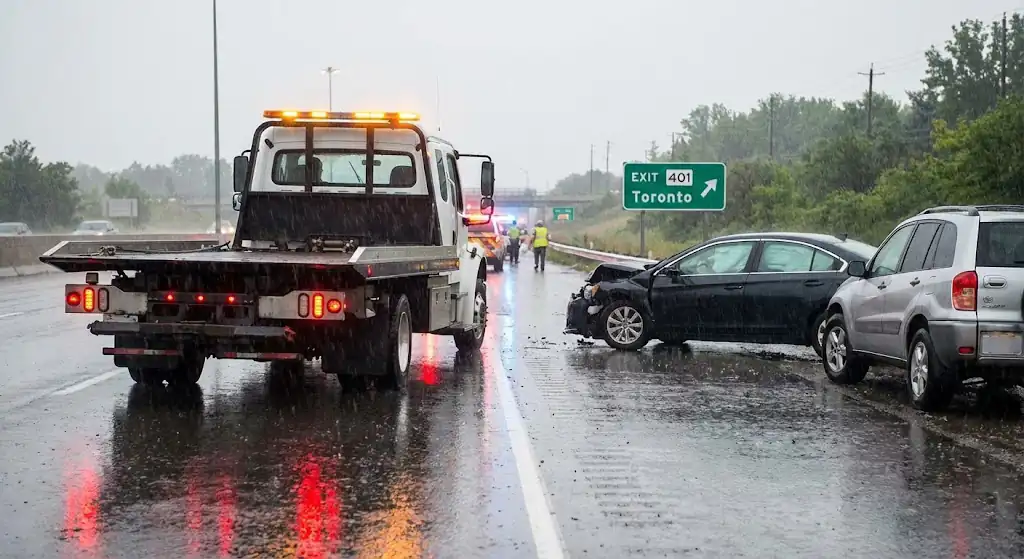
Arrange Towing (If Your Vehicle Isn’t Driveable)
If your car can’t be safely driven, call (902) 593-3918 for accident towing. A flatbed tow is recommended for collision-damaged vehicles to avoid additional damage. We can tow to the police station, a body shop, or your home — your call. Check if your auto insurance includes towing coverage so you can submit for reimbursement.
File Your Accident Report (Within 24 Hours)
This is the formal filing step. Where you report depends on where the collision occurred — see the section below for location-specific instructions. Bring all documents, photos, and the information you exchanged with the other driver. The police will assign you a GO# (General Occurrence Number) — the reference number your insurance company needs.
Contact Your Insurance Company
Notify your insurer as soon as possible — most have 24-hour claims lines. Provide your GO#, photos, and the other driver’s information. Nova Scotia operates under a no-fault insurance system, meaning your own insurer handles your claim regardless of who caused the collision. Don’t wait for the GO# to make first contact — call your insurer the same day.
See a Doctor (Even If You Feel Fine)
Soft tissue injuries like whiplash often don’t present symptoms for 24–72 hours after a collision. Getting a medical assessment creates a documented record that links any injuries to the accident — important if you need to file a personal injury claim later. Visit a walk-in clinic or your family doctor within a few days of the collision.
Where to File Your Accident Report in Nova Scotia
The reporting process differs depending on where in Nova Scotia your collision occurred. Nova Scotia has three types of police jurisdictions:
💡 Key Rule: You must report to the police service that has jurisdiction where the collision happened — not where you live. A Halifax resident who gets into a collision in Truro reports to the Colchester RCMP detachment, not Halifax Regional Police.
Vehicle Not Driveable After Your Accident?
24/7 accident towing across Halifax — flatbed service for collision-damaged vehicles
(902) 593-3918
Understanding Your GO# (General Occurrence Number)
When police process your collision report, they assign a GO# (General Occurrence Number). This is the single most important piece of information for your insurance claim. Here’s what you need to know:
It links your insurance claim to the official police record. Your insurer uses it to pull the accident details, verify your account, and begin processing your claim.
In person: typically at the time of filing. By email (Halifax): police will call you back with it within several business days, though backlogs may increase this.
Contact your insurer anyway. Tell them you’ve filed a report and are awaiting your GO#. Most insurers will begin your claim based on your verbal account and photos while the GO# is processed.
Write your GO# down, photograph it, and save it in your phone. You’ll need it multiple times — for your insurer, for the body shop, and for obtaining copies of the official report later.
How Nova Scotia’s No-Fault Insurance Connects to Your Accident Report
Nova Scotia uses a no-fault insurance system for vehicle damage claims. This is often misunderstood, so here’s what it means for you after filing an accident report:
- You claim through your own insurer — Regardless of who caused the collision, your insurance company handles your vehicle repair and medical benefits.
- Fault is still determined — Insurance adjusters determine fault based on your collision report, photos, witness statements, and the official police report. Fault affects your future premiums.
- Your GO# speeds everything up — Without it, your insurer may delay processing. Filing your accident report promptly and getting your GO# is the single most impactful thing you can do to accelerate your claim.
- Keep all receipts — Towing costs, rental car expenses, and medical visits related to the collision may be reimbursable under your policy. Save everything.
For details on how auto insurance covers towing in Nova Scotia, read our guide on insurance and towing coverage.
7 Mistakes to Avoid When Filing Your Accident Report
Insurance claims get complicated or denied when drivers make these avoidable errors during the reporting process:
Admitting fault at the scene — Saying “I’m sorry” or “it was my fault” can be used against you by insurance adjusters. Stick to factual descriptions of what happened.
Missing the 24-hour reporting deadline — Late reports can result in fines and make your insurer question the claim. File the same day if possible.
Not taking enough photos — You can never have too many. Photos are the strongest evidence you can provide. Take 20+ photos from every angle including wide shots showing the full scene.
Assuming minor damage means no report needed — A bumper that looks slightly scratched can cost $2,500+ to repair once a body shop removes it and inspects the underlying structure.
Posting about the accident on social media — Anything you share publicly can be used by the other party’s insurer. Keep all details private until your claim is fully resolved.
Not seeing a doctor — Whiplash and other soft tissue injuries can take days to present. Without medical documentation linking the injury to the collision, a personal injury claim becomes much harder.
Losing your towing and repair receipts — Keep every receipt related to the collision including towing, rental cars, medical visits, and parking. These may be reimbursable under your policy.
Special Situations: Hit-and-Run, Single Vehicle, and Parking Lot Accidents
Not all collisions involve two drivers exchanging information on the road. Here’s how reporting works for common special scenarios:
Hit-and-Run
Call police immediately — 911 if it just happened. Try to note the licence plate, vehicle make and colour, and direction of travel. Hit-and-runs are criminal offences in Nova Scotia. File your accident report as normal and contact your insurer — your own policy’s coverage handles the claim.
Single Vehicle Accident
If you hit a guardrail, ditch, animal, or other object with no other vehicles involved, you must still report if damage exceeds $2,000 or anyone is injured. For collisions with animals (deer, moose), call 911 if the animal is still on the road and poses a danger to other traffic.
Parking Lot Collision
If you hit a parked, unattended vehicle, Nova Scotia law requires you to make reasonable efforts to locate the owner. If you can’t find them, you must notify police within 24 hours. Leave a note with your name and contact information on the damaged vehicle while you arrange reporting.
Collision on a Highway
Highway collisions require extra safety precautions. Move vehicles off the travelled lane if possible, turn on hazard lights, and set up reflective triangles if you have an emergency roadside kit. If vehicles can’t be moved, call 911 for traffic management. Read more about what to do while waiting for help on the road.
How to Get a Copy of Your Accident Report Later
After filing, you may need an official copy of your collision report for insurance disputes, legal proceedings, or personal records. Here’s how to obtain one in Nova Scotia:
- From Halifax Regional Police: Contact Traffic Support Services at 902-490-3868 or email hrpsot@halifax.ca with your GO# and request a copy.
- From the RCMP: Contact your local detachment with your file number to request a report copy.
- Driver’s Abstract: A comprehensive driving record (including collision history) can be ordered through Service Nova Scotia Registry of Motor Vehicles by mail for a fee. Processing takes approximately three business days.
Accident Towing Across Halifax
Need your vehicle moved after a collision? Halifax Towing provides 24/7 accident towing with flatbed service across the entire HRM:
We cover all major highways (102, 103, 107, 111) and every road in the HRM. View our full service area for details. For a full breakdown of what towing costs after an accident, see our Halifax towing cost guide.
Frequently Asked Questions About Filing an Accident Report in Nova Scotia
How long do I have to file an accident report in Nova Scotia?
You must report within 24 hours if there are injuries, property damage exceeds $2,000, or criminal activity is involved. For minor incidents under $2,000 with no injuries, reporting is optional but strongly recommended to protect your interests.
Can I file an accident report online in Nova Scotia?
In Halifax, you can file by email to hrpsot@halifax.ca (documents in PDF format). For RCMP jurisdictions, some incident types can be reported through the RCMP online reporting tool, though collision reporting availability varies. Filing in person remains the most reliable method.
What is a GO# and why does my insurance need it?
A GO# (General Occurrence Number) is the police file number for your collision. Your insurance company uses it to access the official police report, verify the incident details, and process your claim. Without it, your claim may be delayed.
Do I report to police or my insurance company first?
Both — as soon as possible. Call your insurer the same day, even before you have your GO#. File the police report within 24 hours. Then provide your GO# to your insurer once you receive it.
What if I wasn’t at fault — do I still need to file a report?
Yes. Reporting requirements apply to all drivers involved in a collision, regardless of fault. Your report protects your interests and provides your side of the story for the official record.
What happens if I don’t file an accident report in Nova Scotia?
Failing to report a qualifying collision within 24 hours is a violation of the Motor Vehicle Act and can result in fines. It can also complicate or delay your insurance claim and make it harder to prove your version of events if fault is disputed later.
Is there an accident reporting center in Halifax?
Halifax does not have a standalone accident reporting center. A pilot collision reporting centre operated at Police Headquarters from September 2014 to May 2015 before closing. You now report in person at Police HQ (1975 Gottingen Street, 24/7), at division offices during business hours, or by email.
How does no-fault insurance work in Nova Scotia?
Under Nova Scotia’s no-fault system, your own insurance company handles your vehicle damage and medical benefits regardless of who caused the collision. Fault is still determined by adjusters and affects your premiums, but you don’t have to wait for fault determination before your claim is processed.
Does my auto insurance cover towing after an accident?
Many Nova Scotia auto policies include roadside assistance and towing coverage. Check your policy or call your insurer’s 24-hour claims line. Even if covered, you may need to pay the towing company directly and submit for reimbursement — always keep your receipt.
What should I do if the other driver refuses to share information?
Photograph their licence plate and vehicle from a safe distance. Call the non-emergency police line (902-490-5020 in Halifax) to report the situation. The police can follow up using the licence plate to identify the other driver. Do not engage in any confrontation.
Been in an Accident in Halifax?
24/7 accident towing to police stations, body shops, or your home
Flatbed service recommended for all collision-damaged vehicles
(902) 593-3918