Motorcycle Towing Halifax: Safe Transport for Your Bike
Your motorcycle isn’t just a vehicle — it’s an investment, a passion, and often irreplaceable. According to Transport Canada, motorcycles require specialized handling during transport due to their unique stability and structural characteristics. So when your bike needs to be towed, the stakes are higher than with a car. A motorcycle towed incorrectly can come back with scratched paint, bent handlebars, cracked fairings, or worse — frame damage that makes it unsafe to ride.
The problem is that most towing companies are set up for cars and trucks. They don’t carry motorcycle-specific equipment, their operators aren’t trained on two-wheeled loading, and they may use methods that work for a Honda Civic but will destroy a Harley-Davidson. This guide explains exactly how proper motorcycle towing works, what to look for in a service, and how to make sure your bike arrives in the same condition it left.
Whether you’ve broken down on the highway, need seasonal motorcycle transport, or your bike won’t start after winter storage, Halifax Towing provides dedicated motorcycle towing with the right equipment and training for every type of bike.
Why Motorcycles Need Specialized Towing
You wouldn’t tow a Ferrari the same way you’d tow a pickup truck. Motorcycles demand even more care — here’s why standard car-towing methods don’t work:
A car sits on four wheels and won’t fall over. A motorcycle will. Every bump, turn, and acceleration during transport shifts weight and creates forces that try to topple the bike. Without proper strapping at multiple points, the bike will go down on the flatbed — guaranteed.
Cars have bumpers and door panels designed to absorb minor contact. Motorcycles have chrome, custom paint, carbon fibre, and polished aluminum — all exposed, all easily damaged by metal hooks, chains, or even rough ratchet straps placed incorrectly.
Handlebars, mirrors, brake levers, turn signals, and exhaust pipes all protrude and can be bent or snapped if the bike shifts during transport. The front fork, triple clamp, and steering head are precision components that don’t tolerate side-loading forces well.
A scratched tank on a Harley can cost $500–$1,500 to repaint. A cracked fairing on a sport bike: $300–$800 per panel. Bent handlebars: $150–$400. These are avoidable costs when the towing company knows what they’re doing.
How Proper Motorcycle Towing Works (Step by Step)
When you call for motorcycle towing, here’s the process a professional service should follow. If a tow operator skips any of these steps, that’s a red flag:
Types of Motorcycles We Tow in Halifax
Every bike type has different loading and securing considerations. Our motorcycle towing service handles them all:
Harley-Davidson, Indian, Honda Shadow — heavy, low centre of gravity, wide handlebars
Yamaha R1, Kawasaki Ninja, Ducati — delicate fairings, clip-on bars, high value
BMW GS, Honda Gold Wing — tall, heavy with luggage, high centre of gravity
Custom builds, bobbers — non-standard tie-down points, often irreplaceable parts
KTM, Honda CRF, Yamaha WR — lighter weight, taller suspension travel, knobby tires
Zero, Energica, LiveWire — same securing needs, heavier battery weight, no transmission to put in gear
Common Reasons You’ll Need Motorcycle Towing in Halifax
Knowing when to call for motorbike towing instead of trying to ride home can save you from injury or further vehicle damage:
Engine won’t start, electrical failure, chain break, clutch cable snap, or overheating. If the bike can’t be ridden safely, it needs a tow to a mechanic.
Unlike cars, most motorcycles don’t carry a spare tire. A flat means you’re stranded. Riding on a flat motorcycle tire is extremely dangerous — the rim can cut through the tire and cause a loss of control. Call for motorcycle towing instead.
After any motorcycle accident — even a low-speed tip-over — the bike should be professionally inspected before riding. Bent handlebars, a misaligned frame, or a cracked brake line may not be obvious but can be life-threatening. We provide accident towing for motorcycles with damage-careful loading.
If a battery boost doesn’t work and the battery is dead beyond revival, the bike needs a tow to a shop for battery replacement. Motorcycle batteries are small and fail faster than car batteries — especially after winter storage.
Moving a bike to or from winter storage, or transporting it to a seasonal maintenance appointment. Many Halifax riders store bikes outside the HRM and need motorcycle transport to bring it home in spring or to storage in fall.
Bought a bike from a private seller or dealership and need it delivered to your home? Or sold one and need to get it to the buyer? Motorcycle transport is safer and easier than riding an unfamiliar bike home, especially if it’s not plated or insured yet.
Need Your Motorcycle Towed?
24/7 flatbed motorcycle towing across Halifax — soft-loop straps, wheel chock, damage-free transport
(902) 593-3918
How to Choose a Motorcycle Towing Service (7 Questions to Ask)
Not all towing companies handle motorcycles well. When searching for motorcycle towing near me, ask these questions before handing over your keys:
“Do you use a flatbed?” — If the answer is anything other than yes, hang up. Wheel-lift and hook-and-chain trucks are not safe for motorcycles.
“Do you carry soft-loop tie-downs?” — Metal hooks directly on chrome, plastic, or paint will scratch and damage. Soft loops protect contact surfaces.
“Do you have a wheel chock or front-stop?” — The front wheel must be secured to prevent the bike from rolling and tipping during transport.
“Have you towed motorcycles before?” — Experience matters. An operator unfamiliar with bikes can cause more damage than the breakdown itself.
“How do you load a bike that won’t roll?” — A good service has motorcycle dollies or knows how to safely manually load. Winching a bike sideways is a damage guarantee.
“Are you insured for motorcycle transport?” — If the tow operator damages your bike, their insurance should cover it. Verify they carry cargo liability coverage.
“What does it cost?” — Get a clear price upfront. Motorcycle towing should cost $75–$200 for local transport in Halifax depending on distance and time of day.
Motorcycle Towing Costs in Halifax
Here’s what motorcycle towing typically costs in the Halifax area:
Motorcycle towing typically costs less than car towing because bikes are lighter and take less deck space. Check whether your insurance includes towing coverage — many policies cover motorcycle towing the same as car towing. For a full cost breakdown, see our Halifax towing cost guide.
What to Do While Waiting for Motorcycle Towing
You’ve called for a tow — here’s how to keep yourself and your bike safe while you wait:
Move the bike off the road if possible. Push it onto the shoulder, sidewalk, or parking lot. Use the kickstand on a hard, flat surface — not gravel or soft ground where it can sink and tip.
Make yourself visible. Keep your helmet on if you’re near traffic. Wear your high-vis gear if you have it. Stand behind a guardrail or barrier, not between the bike and traffic.
Photograph the bike’s current condition. Take photos of any existing scratches, dents, or damage before the tow operator arrives. This protects you if there’s a dispute about transport damage later.
Remove valuables and saddlebags. Take your saddlebag contents, tank bag, GPS, phone mount, and any loose items. These can shift or fall off during transport.
Share your exact location. Drop a Google Maps pin and text it to the tow service. On highways, note the nearest exit number or km marker. For more tips, see our guide on what to do while waiting for a tow.
Seasonal Motorcycle Transport: Spring & Fall Tips
Halifax’s riding season runs roughly May through October. If you store your bike off-site or need it transported to/from a maintenance shop for seasonal service, here’s what to prepare:
🌱 Spring (Storage → Home)
- Charge or replace the battery before transport
- Check tire pressure — winter storage deflates tires
- Ensure no rodent damage to wiring or air filters
- Fresh fuel if the tank was drained for storage
- Book transport early — spring is peak demand
🍂 Fall (Home → Storage)
- Fill the tank and add fuel stabilizer
- Clean the bike thoroughly before storing
- Remove the battery or connect a maintainer
- Cover the exhaust and air intake to prevent moisture
- Communicate storage location details to the tow service
Motorcycle Towing Across Halifax
Halifax Towing provides 24/7 motorcycle towing with flatbed service across the entire HRM. Also available: battery boost, roadside assistance, and 24-hour towing for all vehicle types.
We also handle longer-distance motorcycle transport outside the HRM for seasonal moves, purchases, and dealership deliveries. View our full service area. For an emergency roadside kit every rider should carry, check our guide.
Frequently Asked Questions About Motorcycle Towing
How much does motorcycle towing cost in Halifax?
Local motorcycle towing within the HRM typically costs $75–$150 during regular hours and $100–$200 for after-hours service. Longer-distance transport runs $150–$350+. These rates include flatbed loading, soft-loop tie-downs, and unloading. Call (902) 593-3918 for an exact quote based on your location.
Is there motorcycle towing near me in Halifax?
Yes — Halifax Towing provides 24/7 motorcycle towing with flatbed service across the entire HRM including Downtown Halifax, Dartmouth, Bedford, Clayton Park, Cole Harbour, and all surrounding areas. We also handle longer-distance motorcycle transport outside Halifax. Call (902) 593-3918 anytime.
Can a regular tow truck tow a motorcycle?
Only a flatbed tow truck should be used for motorcycles. Wheel-lift and hook-and-chain trucks are designed for four-wheeled vehicles and can damage a motorcycle’s forks, frame, and bodywork. Always confirm the towing service will send a flatbed before agreeing to the tow.
How should a motorcycle be secured on a flatbed?
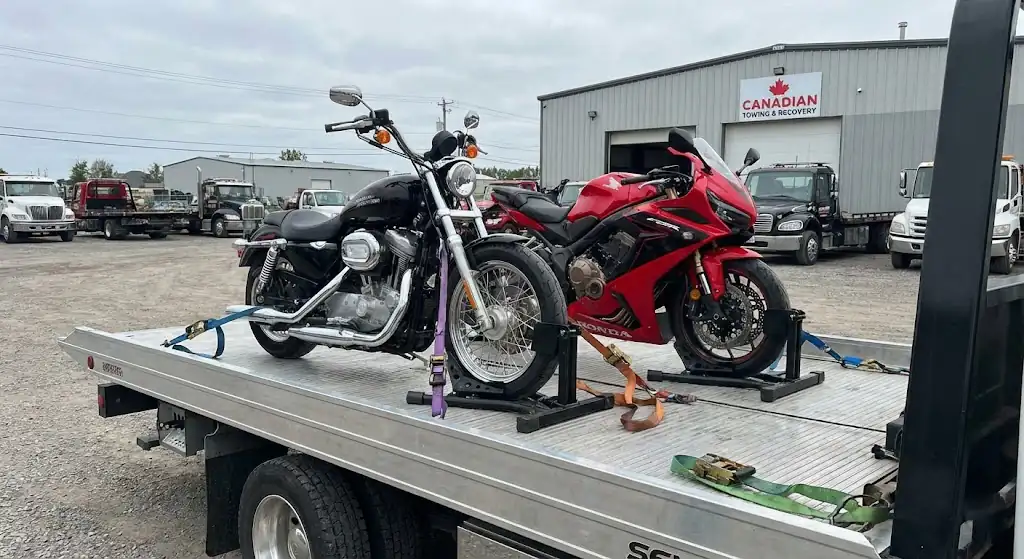
A properly secured motorcycle uses a front wheel chock, four soft-loop tie-down straps (two front, two rear), with the front forks slightly compressed under strap tension. The transmission should be in gear and the steering locked. Metal hooks should never contact chrome, paint, or plastic — soft loops go between the hook and the bike.
Can you tow a motorcycle that’s been in an accident?
Yes — we handle accident-damaged motorcycles with extra care. If the bike is on its side, we safely upright it before loading. If wheels won’t roll due to damage, we use a dolly or manual loading. We photograph the bike’s condition before and during loading for your insurance records.
Do you offer seasonal motorcycle transport?
Yes — we transport motorcycles to and from winter storage locations, maintenance shops, and between addresses. This is a popular service in Halifax during spring (bringing bikes out of storage) and fall (putting them away). Book early in spring as demand is highest in April and May.
Does motorcycle insurance cover towing?
Many Nova Scotia motorcycle insurance policies include roadside assistance and towing coverage. CAA membership also covers motorcycle towing at most membership tiers. Check your policy or call your insurer’s 24-hour line. Even if covered, you may need to pay upfront and submit for reimbursement.
Can you transport a motorcycle I just purchased?
Absolutely — private sale pickups and dealership deliveries are a common service. This is often safer than riding an unfamiliar bike home, especially if it’s unplated, uninsured, or you’re not yet comfortable with its handling characteristics. We pick up from any location in or around Halifax.
What types of motorcycles can you tow?
We tow all types: cruisers, sport bikes, touring bikes, adventure bikes, customs, choppers, dirt bikes, dual-sport, scooters, and electric motorcycles. Each type has different securing requirements and our operators are trained to handle them all safely.
Should I photograph my motorcycle before the tow truck arrives?
Yes — always take photos of your bike’s current condition before loading. Photograph all sides, any existing damage, and close-ups of chrome, paint, and fairings. This documents the bike’s pre-transport condition and protects you if there’s any dispute about damage during towing.
Need Your Motorcycle Towed in Halifax?
24/7 flatbed service with motorcycle-specific equipment
Soft-loop tie-downs, wheel chock, experienced operators
(902) 593-3918