
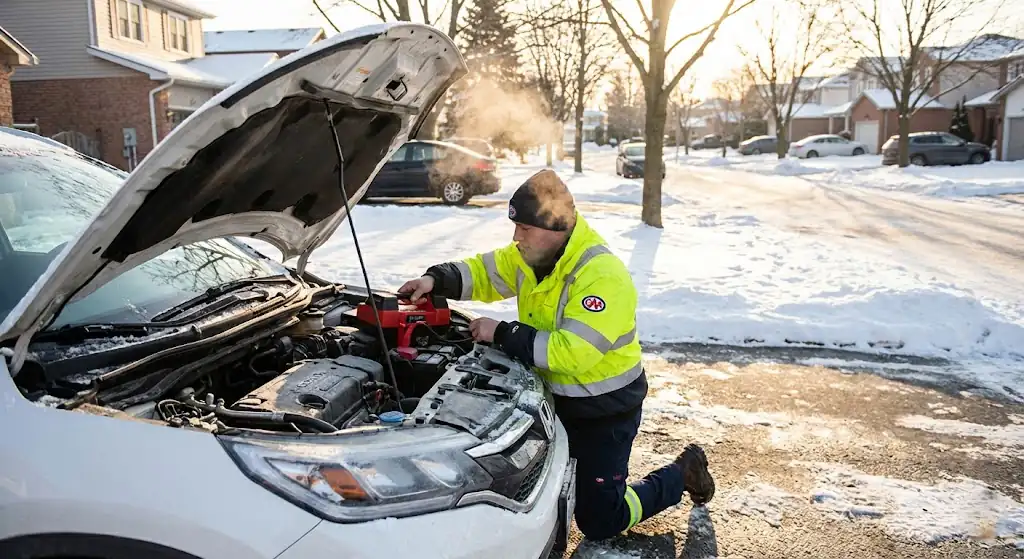
How to Boost a Car Battery Safely: Halifax Roadside Guide
It’s a January morning in Halifax, it’s −15°C, and your car won’t start. The dashboard flickers weakly, the starter clicks but won’t turn over, and you’re already late. A dead battery is the most common roadside problem in Nova Scotia — and knowing how to boost a car battery properly can get you moving in minutes instead of hours.
But here’s the thing most people don’t realize: connecting jumper cables in the wrong order can damage your vehicle’s electrical system, fry the alternator, or — in rare cases — cause the battery to spark or vent hydrogen gas. The correct procedure takes less than five minutes and protects both vehicles.
This guide covers the safe step-by-step process, what tools you need, the most common mistakes, and when it’s time to skip DIY and call for a professional battery boost service instead.
⚠️ Before You Start — Safety Check
If your battery is cracked, leaking, bulging, or smells like rotten eggs (hydrogen sulfide), do NOT attempt a boost. These are signs of a failed or dangerous battery. Transport Canada recommends having damaged batteries inspected by a professional. Call (902) 593-3918 for roadside assistance or a tow to a mechanic. A damaged battery can vent flammable gas and cause a fire or explosion when charged.
🔧 What You Need to Boost a Car Battery
Before you start, make sure you have these items. If you’re missing any, a car battery booster service can handle it for you:
Heavy-gauge (4–6 gauge) cables at least 12 feet long. Longer cables (16–20 feet) give you more flexibility when positioning vehicles.
Any vehicle with a fully charged battery of similar or higher voltage (most cars are 12V). Make sure it’s running reliably.
Protect against acid splashes and sparks. Not required, but especially smart in cold weather when batteries are under more stress.
A lithium-ion jump starter pack ($60–$150) eliminates the need for a second car. Keep one in your emergency roadside kit — they work even in Halifax winters.
⚡ Step-by-Step: How to Boost a Car Battery With Jumper Cables
Follow this exact order. The connection sequence matters — it’s designed to minimize spark risk near the battery:
Position the vehicles
Park the working car close enough for cables to reach, but do not let the vehicles touch. Both cars should be in Park (or neutral for manual), ignition off, parking brakes engaged. Open both hoods and locate the batteries.
Connect RED (+) to the DEAD battery
Clamp one end of the red (positive) cable to the positive (+) terminal on the dead battery. The positive terminal is usually marked with a + symbol and often has a red cap or cover.
Connect RED (+) to the GOOD battery
Clamp the other end of the red cable to the positive (+) terminal on the working car’s battery. You’ve now completed the positive connection between both batteries.
Connect BLACK (−) to the GOOD battery
Clamp one end of the black (negative) cable to the negative (−) terminal on the working car’s battery.
Connect BLACK (−) to BARE METAL on the DEAD car ⚠️
This is the step most people get wrong. Clamp the other end of the black cable to an unpainted metal surface on the dead car’s engine block or frame — a bolt, bracket, or strut tower works well. Do NOT connect it to the dead battery’s negative terminal. This prevents sparks near the battery where hydrogen gas may have accumulated.
Start the working car
Start the donor car’s engine and let it idle for 2–3 minutes. This charges the dead battery enough to attempt a start. In extremely cold weather (−20°C and below), wait 5 minutes — cold batteries need more time to accept a charge.
Start the dead car
Turn the key (or press the start button) on the dead car. If it starts, great — let it idle. If it doesn’t start after 5 seconds, stop and wait another 2–3 minutes before trying again. Don’t crank for more than 5 seconds at a time — you’ll overheat the starter motor.
Disconnect cables in REVERSE order
Once the dead car is running, remove cables in this exact order:
🔋 After the Boost: Drive for at least 20–30 minutes to let the alternator recharge the battery. Short trips won’t fully recharge it, and you may end up with another dead battery the next morning. If the battery dies again within 24 hours, it’s likely failed and needs replacement.
📦 How to Use a Portable Jump Starter
A portable car battery booster pack is simpler than jumper cables because you don’t need a second vehicle. Here’s the process:
Make sure the jump starter is fully charged (charge it at home monthly)
Connect red (+) clamp to battery positive, black (−) to bare metal (same as cables)
Turn on the jump starter unit, wait 30 seconds
Start the car — if it cranks but doesn’t start, wait 2 minutes and try again
Disconnect the jump starter once the engine is running, then drive 20+ minutes
Portable jump starters are a smart addition to any emergency roadside kit. Most modern lithium-ion models are the size of a smartphone and can start a car 10–20 times on a single charge — even in Halifax’s coldest winter temperatures.
🚫 7 Mistakes People Make When Trying to Boost a Car Battery
Connecting the black cable to the dead battery’s negative terminal — This is the most common and most dangerous mistake. Any spark at the dead battery can ignite hydrogen gas. Always ground to bare metal away from the battery.
Mixing up positive and negative — Reversing polarity can fry your car’s ECU, alternator, fuses, and other electronics. The bill for this mistake starts at $500 and can reach $2,000+. Red is always positive. Black is always negative.
Cranking the dead car immediately — Give the dead battery 2–3 minutes to charge from the donor car before attempting to start. In cold weather, wait even longer (5 minutes). Patience prevents damage to both starters.
Using thin, cheap cables — Budget cables with thin wire can’t carry enough current to boost a vehicle with a large engine. Invest in 4–6 gauge cables rated for 400+ amps. Your Halifax winter self will thank you.
Letting cables dangle and touch — If the positive and negative clamps touch while connected, it creates a short circuit. Lay cables out on the engine before connecting, and have your helper hold them separated while you work.
Turning off the boosted car too soon — After a successful boost, drive for at least 20–30 minutes. A quick 5-minute drive won’t recharge the battery enough, and you’ll be stranded again the next time you park.
Boosting a completely frozen battery — In extreme Halifax cold, a deeply discharged battery can freeze internally. Boosting a frozen battery won’t work and can cause the case to crack. If the battery sides feel swollen or you hear liquid sloshing, it may be frozen — call for a battery boost or tow instead.
Dead Battery? No Cables? No Problem.
24/7 battery boost service across Halifax — we come to you
(902) 593-3918
📞 When to Skip DIY and Call for a Professional Battery Boost
Sometimes a DIY battery boost isn’t the right call. Here are the situations where professional help is faster, safer, or simply the only option:
- You don’t have jumper cables or a jump starter
- No other vehicle is available nearby
- You’ve tried twice and the engine won’t turn over
- You’re in an unsafe location (highway shoulder, dark area)
- You’re not confident in the cable connection process
- It’s below −20°C and the battery feels frozen
- Battery is cracked, leaking, or visibly damaged
- Battery is more than 4–5 years old and keeps dying
- Boost works but the car stalls within minutes
- Dashboard shows alternator or charging system warning
- You hear clicking but the engine doesn’t crank at all
- Corrosion has eaten through the battery terminals
Halifax Towing offers 24/7 battery boost service across the HRM. If a boost doesn’t solve the problem, we can tow you to a mechanic on the spot — no need to call a second service. We also offer flatbed towing if the car needs to be moved without running.
❄️ Halifax Winter Battery Tips: Prevent Dead Batteries Before They Happen
Halifax winters routinely hit −15°C to −25°C, and cold is the #1 killer of car batteries. A battery that works fine at 20°C loses roughly 50% of its cranking power at −20°C. Here’s how to prevent getting stranded:
Test your battery before winter. Any auto parts store will test it for free. If it’s older than 3 years, test it every fall. Replace weak batteries in October, not February when you’re stranded in a grocery store parking lot.
Use a block heater. Plugging in your block heater for 2–3 hours before starting reduces battery strain dramatically. It doesn’t need to run all night — a timer set for 4–5 AM is enough for most mornings.
Clean battery terminals annually. Corrosion (white/green crust on the terminals) adds resistance and reduces charging efficiency. A wire brush and baking soda solution cleans them in 5 minutes.
Turn off accessories before shutting off the engine. Lights, heated seats, and the blower motor all draw from the battery. Turning them off before you shut down reduces parasitic load on the next start.
Drive regularly. A car parked for 2+ weeks in winter can discharge its battery even if it’s new. If you’re not driving often, consider a battery maintainer (trickle charger) to keep it topped up.
Keep a portable jump starter in the car. A lithium-ion pack ($60–$150) works in extreme cold and fits in the glove box. It’s the most useful piece of your emergency roadside kit during Halifax winters.
🔄 Battery Boost vs. Battery Replacement: How to Know
A battery boost is a temporary fix — it gets you driving, but it doesn’t fix a dying battery. Here’s how to tell whether you need a boost or a replacement:
If your battery keeps dying, the issue may not be the battery at all — a failing alternator, parasitic drain (light or module staying on), or corroded connections can cause repeated dead batteries. A mechanic can run a full charging system diagnostic for around $50–$100. If you need a tow to get there, we offer mechanic towing 24 hours a day.
🔎 Signs Your Battery Is Dead vs. Other Problems
Not every no-start is a dead battery. Before you try to boost a car battery, make sure that’s actually the problem. Here’s a quick diagnostic:
Rapid clicking when you turn the key means there’s some power but not enough to turn the starter. This is the classic dead battery sound. A battery boost should fix this.
If absolutely nothing happens — no dome light, no dash — the battery is either completely drained or a cable has come loose. Check the terminal connections first. If they’re tight, you need a boost or replacement.
If the engine cranks at normal speed but doesn’t fire up, the battery is fine — the issue is fuel, ignition, or another system. A boost won’t help. You’ll need a tow to a mechanic.
If your push-to-start doesn’t respond but the car has power, the key fob’s coin cell battery is likely dead. Hold the fob against the start button — most cars have a backup reader built in.
🚛 Battery Boost Service Across Halifax
Searching for a car battery booster near me? Halifax Towing provides 24/7 battery boost service across the entire HRM. We come to you — driveways, parking lots, highway shoulders, wherever you’re stranded:
We cover all HRM highways and side roads. View our full service area. For general roadside help, see our roadside assistance page. Stranded and waiting? Read our guide on what to do while waiting for help.
Frequently Asked Questions About Boosting a Car Battery
Which cable goes on first when you boost a car battery?
Red (positive) goes on first — connect it to the dead battery’s positive terminal, then to the good battery’s positive terminal. The black (negative) cable goes on last, with the final connection to bare metal on the dead car (not the dead battery terminal).
Why shouldn’t you connect the black cable to the dead battery?
A dead or dying battery can vent hydrogen gas. When you make the final cable connection, a small spark is normal. If that spark happens at the battery terminal where hydrogen has accumulated, it can cause the battery to ignite or explode. Connecting to bare metal away from the battery moves the spark to a safe location.
How long should I let the car run after a battery boost?
Drive for at least 20–30 minutes after a boost. This gives the alternator time to recharge the battery to a usable level. Idling alone may not charge the battery quickly enough — driving at road speeds is more effective because the alternator spins faster.
Can boosting a car damage my vehicle’s electronics?
If done correctly, no. If done incorrectly — particularly reversing the positive and negative cables — it can damage the ECU, alternator, fuses, and other electronic components. Following the correct cable order and ensuring proper polarity prevents this risk.
How much does a battery boost service cost in Halifax?
Professional battery boost service in Halifax typically costs between $50 and $100. This includes coming to your location and performing the boost. Call (902) 593-3918 for current pricing. It’s often cheaper and faster than a tow, especially if the battery just needs a jump.
Is there a car battery booster near me in Halifax?
Halifax Towing provides 24/7 battery boost service across the entire HRM including Downtown Halifax, Dartmouth, Bedford, Clayton Park, Cole Harbour, Spryfield, Fairview, North End, and all surrounding areas. Call (902) 593-3918 and we come directly to your location.
Can you boost a car in the rain or snow?
Yes, you can safely boost a battery in rain or snow. Car batteries operate at 12 volts, which is too low to pose an electrocution risk in wet conditions. Just make sure the cable clamps make clean, dry contact with the terminals — wipe off any snow or ice before connecting.
How long does a car battery last in Halifax weather?
In Halifax’s climate with cold winters and hot summers, most car batteries last 3–5 years. Batteries in colder climates tend to have shorter lifespans because extreme cold puts more strain on them. Have your battery tested every fall after it reaches the 3-year mark.
Can I boost a hybrid or electric vehicle?
Most hybrids have a separate 12V battery that can be boosted using the same process. However, never attempt to boost the high-voltage traction battery. Fully electric vehicles with a dead 12V battery should be jump-started according to the manufacturer’s instructions — check your owner’s manual. When in doubt, call a professional.
My battery is dead and I have no cables — what should I do?
Call (902) 593-3918 for a professional battery boost. We come to you 24/7 anywhere in Halifax with the equipment to get you started. While you wait, stay in your vehicle with hazard lights on if you’re on or near a road. Read our guide on what to do while waiting for help.
Dead Battery in Halifax?
24/7 battery boost service — we come to your location anywhere in the HRM
If a boost doesn’t fix it, we’ll tow you to a mechanic on the spot
(902) 593-3918